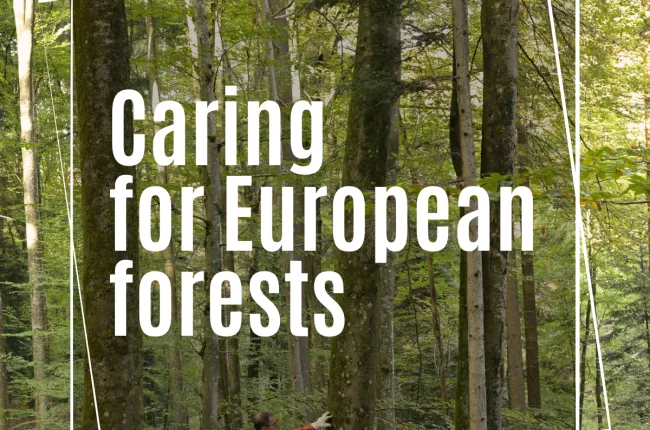
After four years of intensive research and collaboration, the €20 million SUPERB project (Systemic solutions for upscaling of urgent ecosystem restoration for forest-related biodiversity and ecosystem services) is approaching its conclusion. Funded through the EU’s Horizon 2020 Programme, SUPERB has worked to connect scientific knowledge with on-the-ground practice, implementing restoration actions across 12 large-scale demonstration areas with 36 partners from 16 European countries.
As the project enters its final stage, partners, experts and stakeholders came together for the SUPERB Synthesis Webinar, designed to highlight lessons learned, explore remaining challenges, and reflect on the future of forest restoration in Europe.
Participants heard from a wide range of experts, including Gesche Schifferdecker, Elisabeth Schatzdorfer, Iciar Alberdi, Maitane Erdozain Ibarra, Jürgen Bauhus, Gert-Jan Nabuurs, Marcel Hunziker, Yulia Poskakukhina, Sophus zu Ermgassen, Sven Wunder, Jo O’Hara, Hélène Koch (CEPF), and Piotr Borkowski.
The agenda covered:
- The evolution of forest restoration in Europe and key lessons from the past
- Approaches and methods tested across SUPERB’s demonstration sites
- Long-term impacts of restoration on carbon storage, biodiversity and wood provision
- Societal perceptions of restoration and the importance of stakeholder engagement
- Biodiversity credits, nature markets, and current opportunities and constraints
- The Restoration Marketplace and the Forest Knowledge Gateway, two tools designed to support practitioners and decision-makers
- A restoration case study from the Polish State Forests (EUSTAFOR)
Throughout the webinar, speakers underlined the critical role of forest owners, local communities and broader stakeholder networks in achieving restoration at scale. As highlighted by several panelists, the success of long-term restoration depends on trust, respect for landowners’ rights, and clear benefits that motivate continued engagement.
Discussions also pointed to the growing role of private finance, nature markets and innovative incentive mechanisms, which are increasingly shaping the landscape for forest restoration across Europe.
One of the closing reflections came from Jędrzej Damski of the Polish State Forests, who shared the words of a field forester:
“It’s not a question if storms will come – only how well we’re prepared, and what we choose to do when they return.”
The session concluded with an open discussion and reflections on how European restoration efforts can continue to build momentum beyond the project’s completion.
As SUPERB wraps up its activities, the tools, knowledge and networks developed through the project will continue to support practitioners, researchers and policymakers well beyond its formal conclusion. The project’s legacy lies in the models it has created for collaboration, stakeholder engagement and evidence-based restoration—key foundations for scaling up nature-based solutions in Europe.
You can watch the recording of the webinar via embedded video below, or via YouTube.