
CEPF Reflections on the new EU Bioeconomy Strategy
11 February 2026
CEPF welcomes the adoption of Commission’s communication the new EU Bioeconomy Strategy, which is regarded as an important step in the right direction. Looking to the further formulation of the EU’s bioeconomy policy framework, European forest owners call on the EU co legislators to:
•Recognize and strengthen the role of family forest owners as central actors in Europe’s bioeconomy and forest based value chains
•Signal strong political commitment to increasing the production of domestic, sustainably sourced renewable biomass, which is essential for Europe’s strategic autonomy
•Prioritize locally adapted Sustainable Forest Management (SFM) as the guiding principle, supported by continued cooperation with Forest Europe
•Shift climate policy emphasis from “sink-only” to “sink-substitution”, with clear recognition in future LULUCF revisions beyond 2030
•Recognize and strengthen the role of family forest owners as central actors in Europe’s bioeconomy and forest based value chains
•Signal strong political commitment to increasing the production of domestic, sustainably sourced renewable biomass, which is essential for Europe’s strategic autonomy
•Prioritize locally adapted Sustainable Forest Management (SFM) as the guiding principle, supported by continued cooperation with Forest Europe
•Shift climate policy emphasis from “sink-only” to “sink-substitution”, with clear recognition in future LULUCF revisions beyond 2030

CEPF's reply to the Commission's call for feedback on the carbon farming methodologies
19 February 2026
CEPF welcomes the progress on the afforestation methodology under CRCF but highlights persistent challenges, including disproportionate monitoring burdens, restrictive eligibility criteria, and the need for clearer safeguards against changing legislation, calling for a more practical and inclusive framework for European forest owners.

Managed forests, lower wildfire risks - Turning proven knowledge into operational practices
19 February 2026
Wildfire risks are rising across Europe. CEPF position paper calls for a unified yet flexible EU approach built on active Sustainable Forest Management. By reducing fuel loads, strengthening forest-based bioeconomy, aligning policies, and enhancing preparedness and coordination, Europe can turn proven knowledge into real action on the ground and build landscapes that are more resilient to wildfire.

EC High-Level Roundtable on Wildfire Risk Management
30 January 2026
CEPF intervened at a high-level EU roundtable on wildfire risk management, urging the Commission to recognise active sustainable forest management as the foundation of wildfire resilience in its upcoming Communication.
EC Implementation Dialogue on the Nitrates, Water Framework, and Nature Directives
18 February 2026
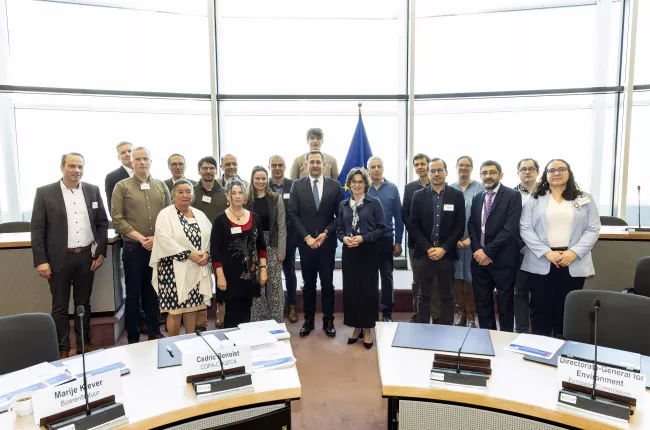
CEPF joined Commissioners Roswall and Hansen at a high-level event, making the case that fit-for-purpose nature protection legislation and active forest management should go hand in hand.
Joint Statement on the Council Conclusions on the EU Bioeconomy Strategy
18 March 2026
On 17 March, Member States adopted their position on the EU Bioeconomy Strategy. CEPF, together with Copa and Cogeca welcome the Council Conclusions, which underline the strategic role of forest owners in contributing to Europe’s strategic autonomy by providing sustainably sourced homegrown renewable materials for a widening range of use in the bioeconomy, ensured through the management of healthy and resilient forests. European forest owners especially welcome Member State’s explicit call for a predictable coherent policy framework around the European bioeconomy, where the “efficient implementation of the sustainability criteria for biomass set out in current Union legislation” is central for primary producing sectors.

International Day of Forests 2025: Forests and Economies
21 March 2026
Forests play a fundamental role in supporting economies, livelihoods and well-being worldwide. They provide essential resources, generate employment and deliver ecosystem services that underpin productivity across multiple sectors. Ensuring their sustainable management remains key to maintaining these benefits over time.
CEPF's reply to the Commission's call for evidence on applying DNSH principle under the 2028-2034 MFF
1 April 2026
CEPF would like to express fundamental concerns about applying DNSH to public funding under the MFF, as the principle was designed for voluntary private investment classification and is the wrong instrument for public fund governance.

Publication of the State of Europe's Forests 2025 report
30 March 2026
On 27 March, Forest Europe published its State of Europe's Forests 2025 report. The reported indicators show that despite the increasing number and impacts of natural disturbances due to climate change, and the increasing complexity of making decisions regarding sustainable forest management, forests continue to provide their multifunctional role and bring the many benefits (economic, environmental and social) that society expects.
CEPF 30th Anniversary Celebration
2 April 2026
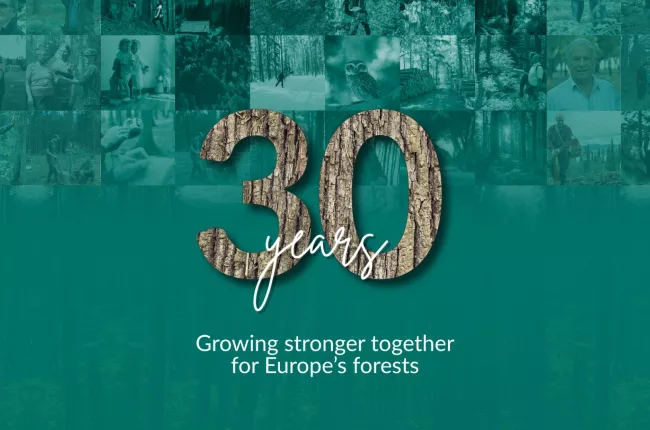
On 26 March 2026, CEPF marked its 30th anniversary in Brussels, bringing together forest owners, EU policymakers and forest-based stakeholders from across Europe. The event highlighted the vital role of forests for Europe’s future, reaffirmed CEPF’s core values, and looked ahead to the opportunities for sustainable forest management, innovation and a thriving bioeconomy.
EU publishes its first integrated wildfire risk management strategy
25 March 2026
The European Commission has published its first integrated wildfire risk management strategy, covering prevention, preparedness, response and recovery. Key actions include continued CAP support for active forest management, a strengthened EFFIS monitoring system, and a new Council Recommendation. CEPF welcomes the recognition of active forest management as essential.

CEPF's feedback to the mid-term evaluation of 2023-2027 CAP
3 April 2026
Forest owners' feedback stresses the need to reduce administrative burden, ensure adequate funding for forestry under EAFRD, and safeguard rural development in the future CAP architecture.